Category Archives: Books

The Gardener’s Year

“The Gardener’s Year” by Karel Čapek is not a “How-To” book by any means, rather it’s a reflection of what it is to be a gardener. It is a short book of 160 or so pages, comprising 26 chapters, filled with humorous insights about gardening over the course of a year, with simple cartoon-like illustrations by his brother Josef. It won’t teach you much about gardening, there are many other books that will do that, but it will help you understand why gardeners love gardening so much.

Čapek is better known for having coined the word “Robot” appearing in his play “R.U.R.” first performed in 1921. The “Gardener’s Year” published later, in 1929, by which time Čapek was firmly established in his reputation as a writer, affording him the means to keep a modest garden of a quarter acre in a Prague neighborhood, sharing it with his brother Josef. In this interwar period, shortly before the Wall Street crash of 1929, it is estimated that some 50-65% of Czechs used their gardens for growing food; or if they could not afford a garden, they could pay a minimal rent to lease an allotment. The Capek brothers, therefore, were fortunate indeed to be able to maintain the garden described in the book; a garden featuring numerous perennials, bulbs, a rock garden, and a greenhouse.

Every chapter brings the reader fresh ways of looking at gardening. Čapek writes about the things that you didn’t know you already knew, and experiences that you’ve probably felt but couldn’t put into words. He tackles each subject with genuine insight. Consider the chapter “The Blessed Rain.”

The hissing downpour stops, as if one pulled a string; the earth shines with silver vapour, a blackbird shouts in a bush and plays mad pranks; we also want to kick our heels, but instead we go out with bare heads to breathe in the fresh and sparkling humidity of the air and earth.

The book’s chapters are filled with garden imagery like this, making it the ideal bedside book to read before you turn in. And if you suffer from insomnia and can switch on the light without disturbing the dog, you might want to read a chapter or two to divert your mind from whatever woke you up.

Writing as he did a hundred years ago, about a climate and soil unlike that of New England’s, it may seem that some of his ideas are no longer relevant; his description of how to eradicate green-fly would certainly not pass muster these days. But bear in mind that he writes this to poke fun at the marketing of simplistic panaceas, not dissimilar to what one might find a Tik-Tok influencer promoting (and with equally futile results)!

For this there are various powders, preparations, tinctures, extracts, infusions, and fumigations, arsenic, tobacco, soft soap, and other poisons, which the gardener tries one after the other, as soon as he notices that on the roses the green and succulent lice have seriously increased. If you use these expedients with a certain care, and in due quantity, you will find that the roses sometimes survive this destruction uninjured, except the leaves and buds, which look somewhat blasted, while the plant-lice thrive under this treatment so that they cover the twigs like dense embroidery.

Čapek takes great delight in making fun of problems that will be familiar to all gardeners; be it poring over seed catalogs and ordering far more than you can use; the pursuit of a unique specimen and, having found it, searching in vain for a place where you can plant it; or turning the soil and having to fight with the roots and rocks and assorted debris. Consider the life lessons he draws from his gardening; as relevant today as they were then.

The man who is the owner of some yards of land, and is growing something on it, becomes in fact a rather conservative creature, for he is dependent on natural laws a thousand years old; do what you will, no revolution will hasten the time of germination, or allow the lilac to flower before May; so the man becomes wise and submits to laws and customs.

This is a book that you’ll want to own and lend out to other gardeners. Although available on Kindle and softcover, I recommend you buy the hardcover edition. It’s a small book with ribbon marker, solidly bound on high-quality paper. You can find new and lightly used copies on your favorite used book site.

Life in the Gardeners’ Bothy

“Life in the Gardeners’ Bothy” is a social history of gardening in English landed estates from 1920s to the outbreak of World War Two. This period saw shifts in social structures, with the rise of the working class and the decline of the aristocracy. Arthur Hooper was a gardener on many of these estates, beginning his career at the age of 14  as an unpaid apprentice gardener’s boy, and ending his career in the coveted position of head gardener. Over the course of his career, he worked for many eminent personages:

  • Sir Cecil Chubb. Best known for donating Stonehenge to the nation, a property that he acquired as Lot 15 at an auction for a mere £6,600. He acquired it on a whim as a present for his wife. He wanted to prevent the stones from being acquired by someone overseas. Owner of Bemerton Lodge, a small country estate near Salisbury, Wiltshire.
  • Washington Merritt Grant Singer. American born heir to the Singer sewing machine fortune. Owner of Norman Court, a country estate in Hampshire of about 3,000 acres.
  • Sir Felix Schuster. Born in the Free City of Frankfurt, his family moved to England when he was 15. A wealthy banker and Liberal MP. Owner of Verdley Place, a 67-acre property in West Sussex.
  • Sir Jeremiah Coleman. Developed Colman’s Mustard into an international concern. Owner of Gatton Park, a country estate in Surrey of about 1,000 acres.

In the early days of his career, a garden would have employed 20 to 30 or more gardeners . Gatton Park, for example,  employed 35 gardeners, of which six gardeners alone were required to grow and cross orchids, Sir Jermiah’s particular hobby. And to Hooper’s surprise, one of the gardeners was a woman! Gardeners would be allocated to work maintaining the pleasure grounds, the kitchen gardens, and multiple glasshouses. These latter were heated by one or more boilers; one of the gardener’s duties would be to keep the boilers running 24 hours a day, seven days a week, adjusting ventilators as needed to  maintain  the temperature and within carefully prescribed limits depending on what was being grown there. Hooper lists the following glasshouses at Norman Court:

  • Two peach houses
  • Four  vineries
  • Four plant houses
  • A rose house
  • A house for tender vegetable seedlings
  • An underground forcing room for rhubarb, sea kale, endive, and chicory
  • Two cucumber houses
  • Three melon houses
  • Twp carnation houses
  • A fernery
  • A stove house for tropical plants
  • A chrysanthemum house
  • A tomato house
  • A camelia house

There was a strict hierarchy amongst gardeners. Boys were at the bottom followed by paid journeymen assigned various ranks: 1st journeyman at the top, followed 2nd , 3rd, and 4th, depending on the size of the garden. Above them would be foremen assigned to oversee the work of several men, followed by a general foreman or manager, and above him the almighty head gardener. He alone interacted with the Lord of the Manor and his Lady, to direct the workings of the gardens. Foremen and above would be expected to be married and live on tied houses on the estate. Journeymen, however, had to remain unmarried  and were housed in basic accommodation, called the gardener’s bothy. A gardener’s rank dictated the dress code. A first journeymen was required to wear a collar and tie and wear a blue apron. He could only remove his jacket if the weather was hot, and always be ready to put it back on if the lady or squire came his way. Lesser journeymen wore green aprons.

This was an age when workers were expected to remain subservient to their masters and to acknowledge them by touching their caps if they passed by. Hooper’s spirit comes through however in an interchange with the Sir Simon Schuster’s daughter when he found it necessary to assert some dignity.

I was working in the vinery when I heard Miss Schuster calling me. I came down some steps, walked to the door and out to where she was standing. “When I call you,” she said, “you will not keep me waiting, you will run to me as quickly as possible.” I stood quite still a little away from her. I think I did this because I was to some extent taken aback. Then I said, “Madam, nature doesn’t run, and we who work with nature must keep in step with our natural master.”

Hooper goes into great detail describing the bothys that he lived in. Some were better than others, but shared the same basic setup of a living room with table and chairs, a dresser for crockery and utensils, and large cast iron stove, used for cooking and heating water. A local woman, referred to as the bothy “Mom” was employed by the Head Gardener to do the cooking, mending, and laundry during the week. Bothy boys were also given an allowance of coal and lamp oil, but had to pay for food out of their own wages. Depending on the garden, however, they could sometimes supplement it with produce from the garden. Life in the bothy was equally regimented, with a rotating roster of who would be “on the wheel” for cooking and maintaininng the glasshouse boilers at the weekend.

The Wall Street Crash of 1929 was felt in England as well. Hooper describe how men were abruptly laid off and wages cut. Completion for places at gardens became tight. Hooper’s gardening knowledge and references, however, served him well. His skill as a cricketer though was the deciding factor in his getting a position at Gatton Park; Sir Jeremiah was a keen cricketer!

Hooper eventually landed his coveted position of Head Gardener at Hookstile House in Surrey, a small estate of just 21 acres, employing just three staff. The position was cut short, however, by the outbreak of the Second World War, when the owner, Mr. Horner[1] and his wife closed the house and left to live on his other estate in Devon. Hooper was given notice and returned to work with his father, who at this time had been given charge of several gardens at a psychiatric hospital in Salisbury. As a producer of food, his position was classified as a reserved occupation so he would not be called up, and moreover could not change occupations.

Hooper wrote a second book “After the Gardeners’ Bothy” in 2004, at which time he would have been 96. His date of death remains unrecorded.


[1] Hooper gives the owner’s name as Horler, but property records give it as Horner, I suspect that some other names may be incorrect in the latter part of the book as I have been unable to independently confirm them.

Being Mortal

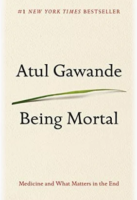
“Being Mortal” is a book I needed to read. It’s beautifully and poignantly written by Atul Gawande, a surgeon at Brigham and Women’s Hospital in Boston, where I spent several months in 2005/6 being treated for and cured of Burkitt Lymphoma. I first became aware of Gawande from the articles he’d written for the New Yorker magazine, but this is the first book of his that I’ve read. He writes with great compassion about the end of life of several of his patients, including that of his own father. He revisits the ancient Ars Moriendi updating it for the modern secular age. Gawande observes that advances in medicine and social organization have not kept pace with the art of dying. He points out that we accept death once it’s over, but it’s the period leading up to death that we find it difficult to deal with. Gawande has long been a proponent of including the patient in medical care and decision making, and here he extends that responsibility to the family. He recognizes that, all too often, doctors can give the impression that their superior knowledge and experience make them solely responsible for making decisions about treatment. This assumes that the doctor’s only job is to prolong life, but although that may be the doctor’s most important job, it is not the only one. Patients also need to retain agency over their lives, and to be able to take care of things important to them. All too often the family is caught between the two: should they listen to the doctor who has experience of treating many patients, or to the patient who is the only one who can say what matters to them. The patient knows that they only have a diminishing amount of time left to them, and may prefer to spend those days in familiar surroundings, with minimal pain, doing things that they care about. The patient may not wish to face the prospect of being subject to painful testing, invasive procedures, and spending time in the ICU; a prospect that  only postpones the ultimate. Even if patients escape this indignity, they may find themselves consigned to long-term care nursing homes. Often this is done for the benefit of a family that, for whatever reason, is unable to take on the responsibility of caring for the individual in their home. Here again there is a conflict between the interests of the caregiver and the patient. The caregiver may feel that they have to provide safe and consistent care, be it waking up the patient at set times for blood draws and taking vitals, dispensing regular doses of medication at set times during the day, and providing a controlled diet for breakfast, lunch, and dinner. Such a program is unlikely to be what the patient wants. Patients, while recognizing that they can’t do just what they did when younger, may still want to do things the caregiver won’t allow. This might include things such as sneaking the odd cigarette and cocktail! Caregivers would be correct in deeming that they are not in the best interests of the patient, but is the caregiver the only one who can decide that? Cannot the patient be allowed to shoulder some of the risk if doing so makes them happy?

Most people who have attended high school in the US, or its equivalent in the UK, will have learned about Maslow’s Hierarchy of Needs, having Self Actualization at its pinnacle. Gawande takes issue with this characterization of human needs as being applicable to everyone. It might be appropriate as a goal for high school students with their lives ahead of them, but for folks at the end of their lives they’ve probably done as much self-actualization as they need. They may be ready to look beyond the self and connect with something greater. As we age, we have more years behind us than ahead of us. We may feel the need to savor the past, atone for past transgressions, and share with others what they’ve learned along the way.

In a section on “Death with Dignity’ Gawande quotes the Stephen Jay Gould, the distinguished evolutionist from his 1985 essay “The Median isn’t the Message.” A few years earlier, in 1982, Gould had been given a diagnosis of Peritoneal Mesothelioma, a rare form of abdominal cancer, and given a life expectancy of 8 months. He actually died, 20 years later, of lung cancer, an entirely different illness. Gould writes:

“It has become, in my view, a bit too trendy to regard the acceptance of death as something tantamount to intrinsic dignity. Of course I agree with the preacher of Ecclesiastes that there is a time to love and a time to die – and when my skein runs out I hope to face the end calmly and in my own way. For most situations, however, I prefer the more martial view that death is the ultimate enemy – and I find nothing reproachable in those who rage mightily against the dying of the light.”

Gould’s case may be exceptional, but Gawande is concerned about the rise of the “Death with Dignity” movement, fearing that it may become the default option for the convenience of family and society when other options exist, including adult communities in the early stages of decline, or hospice towards the end. He recognizes that there are cases where it may be the best option, but questions the significant growth in rates of assisted suicide, currently  around 5% in Canada’s Quebec province and the Netherlands. Ultimately, Gawande comes down on the side of Hospice and Palliative Care (HPM). It is sobering to learn that HPM was only recognized as a specialty by the American Board of Medical Specialties in 2008, lagging the UK by more than 20 years who recognized it as a medical specialty in 1987. But it is also encouraging to learn that palliative care programs in US hospitals with 50 or more beds have increased from 20% in 2000 to 84% in 2022. A search of my health insurance’s website returned 59 HPM specialists in my geographic area.

For all this, addressing the complex issues surrounding the end of life is not easy. There is significant room for policy development in this area, and it is to be hoped that policy makers will read this book, understand it, and find the will to act upon its recommendations.
On Atheism

Every day seems to bring another news story that makes me hope that Trump’s hold on the Republican party is lessening, but it never seems to be enough to persuade his true believers. Why is this so? I think it was several years ago, in 2004, during John Kerry’s run against George W Bush, that I first noticed the tendency of Republicans to believe in any nonsense, so long as it supported their preconceived cultural tenets of selfish personal freedom, that the story is easy enough for even the simplest mind to understand and swallow, and that it is well funded and promoted. Democrats will always be hampered by having to deal with the real world and its complexities. The nonsense in that election, known as the “Swift Boat” controversy was that Kerry engaged in “stolen valor” when citing his experiences in the Vietnam war as reasons for his later anti-war activism. The conservative donors, including Bob Perry and T. Boone Pickens, who funded the Swift Boaters, later funded the Tea Party, which in turn paved the way for Trumpism and the MAGA movement.

So, what does this all have to do with Atheism? Although some of the leaders of the anti-war movement included Abbie Hoffman, an atheist, and Jane Fonda, who grew up atheist, there were others, including John Kerry and Dr. Martin Luther King, who were deeply religious. The issue that concerns me is that the opposing pro-war movement, having birthed MAGA, has also evolved to fully encompass the fundamentalist Christian right. And, after all, for all its good moral advice, if you can believe in the literal infallibility of the bible, including its fantastic stories of Adam and Eve, the Flood, and the parting of the Red Sea, then swallowing Trump’s lies is a piece of cake. I do not intend a blanket condemnation of Christianity, or even some of its stranger offshoots such as Mormonism. As Yuval Harari has observed, humanity’s sharing of common stories has certain evolutionary benefits, and it doesn’t matter if those stories are true or not. There are many upstanding Christians and Mormons who have displayed the courage to stand up to Trump. The problem that I take issue with is that flavor of fundamentalist Christianity espoused by influencers such as Lance Wallnau, Dutch Sheets, and the late Charlie Kirk. These folks enlist the beguiling forces of social media to spread lies that millions eagerly swallow because they feed an underlying yearning for answers.

In my case I grew up Church of England, and like my father was drawn towards the high church version of it. At Bryanston, my public school, I proudly became confirmed and used to voluntarily attend morning services in the school chapel. At Oxford, I would regularly attend mass at St. Mary Magdalene, an Anglo-Catholic high church, where we used the Anglican Missal instead of the usual Book of Common Prayer; we would genuflect before entering the pew and strike the chest at the appropriate time when reciting confession. Even though I was reading Physics, a scientific discipline that requires evidence for its theories, I saw no contradictions with my beliefs, or perhaps I didn’t want to see them. My church going fell into disuse after graduation, but I still considered myself Christian until I experienced an epiphany, fueled, it is true by LSD, while working the grape harvest in France in 1976. I saw myself as just another human in the universe, but connected to every other human in a vast grapevine network. It became clear to me that the only reason I believed in God was because I wanted to. In effect, it was as if God spoke to me and told me that he didn’t exist and there was no need to continue believing in him. It was perhaps like a child finding out that Father Christmas doesn’t exist, but it doesn’t matter because they’re still going to get presents!

Over the years I’ve been fortunate to have worked in different countries and meet people from walks of life whose experiences have been a lot harder than mine. From the barber who came aboard our ship when we docked in Douala, earning less in day than the price of a single beer in a local bar; from Palestinians living without agency under Israeli rule in Gaza; to young adults bowed down by mental challenges at a residential camp in upstate New York. The grapevine network may not be as obvious as it was that night in France, but the image has never left me. It’s easy to understand the bonds of family, neighbors, and friends that make up the local region of one’s network, less easy to understand what binds us to people that we have nothing in common with, that we may in fact be in opposition to, other than the simple truth that we are all human.

With this understanding, I find that I do not need a God to explain the mysteries of the universe. I acknowledge that other people’s upbringing and experiences may have led them to a different conclusion, that a God, or gods exist, but I see no need to dissuade them from these conclusions. I do not expect or need the  universe’s mysteries to be fully revealed to such an insignificant inhabitant as myself – no one understands such a self-evident truth as the workings of quantum mechanics, and perhaps as a race we are not equipped to do so, just as a two-dimensional being in Edwin Abbott’s Flatland is not able to perceive a three-dimensional universe.

What does this say for the future of the US? And indeed, of the UK? And of all countries where Trumpism and its fundamentalist religious cheerleaders have taken power or are on the rise. For those on the Left, railing against it on Facebook is unlikely to yield results, and those on the Right are deluding themselves if they think that their ALL CAPS POSTINGS conflating socialism with communism are having any effect other than shoring up the views of their followers and increasing their hatred of those that don’t agree with them; both groups are already safely ensconced in their bubbles. The sad fact is that people don’t like to change their minds.

Social media is addictive. Rare is the day when I do not find myself dumb-scrolling[1] Threads or some other platform for a quick fix. AI makes this more addictive, because it makes it a challenge to figure out what’s real or not. And, of course, “The Algorithm” knows what I’m interested in and makes sure to feed me more of it. But it’s missing the point to blame social media for what divides us. History tells us of many periods where the population has been similarly divided, from the conflict between Protestants and Roman Catholics begun by King Henry VIII in the 16th Century, ending with Catholic Emancipation in the late 18th Century, only to regenerate with the Northern Ireland troubles in the latter part of the 20th Century. The US’s first civil war, more commonly referred to as the “American Revolution” divided patriots and loyalists in the 18th Century, followed by its second civil war between the Union and the Confederacy in the 19th. Social media, in the form of pamphlets and broadsheets, certainly existed in the past, but since a large part of the population could not read, the messages would have, for the most part, be transmitted by gossip and preaching. It turns out that, humanity’s love of stories and its ability to share them is not only our species “evolutionary superpower,” as Yuval Harari has called it, but also its fatal flaw that may lead to the downfall of our modern society.


[1] I prefer the term “Dumb-scrolling” rather than the more common “Doomscrolling” because I’m not actively looking for bad news.

Dangerous Assumptions

  1. Just because you wrote it, doesn’t mean anybody read it.
  2. Just because they read it, doesn’t mean they understood it.
  3. Just because they understood it, doesn’t mean they agree with it.
  4. Just because they agree with it, doesn’t mean they are going to do anything about it.