First day at rehab. Sleep was not great. Did a morphine refill of 30 mg at 1:30 in the morning. I listened to ambient sounds on my headphone to drown out the snores, grunts, and wheezes of my roommate. I’ve dropped hints to the staff – we’ll see if they can do anything.
Had multiple visits in the morning from Lauren, my OT. Lots of questions about the set up of our house. How many floors? How many steps? What equipment do we have? This was followed by PT, with Evan and Stephany. Evan did most of the assessment with Stephany just watching. I think she’s the senior of the two. He asked many of the same questions as Lauren. He watched and analyzed how I got out of ed, into bed, used the walker, etc. I got into the wheelchair and wheeled myself down the corridor to the gym. I got to see into some of the patient rooms and look at the facilities on the way. Bottom line from OT and PT, I’m pretty strong and able to do things as well as, or better, than expected.
I called Maureen. She’ll be in this afternoon after the gym.
6 pm. Checking in at Encompass. Initial impressions very favorable. I’m sharing a room and I have the window. Abbie, the nurse, checked me in. Dora, a care assistant helped. Dora’s deaf but communicates with her smart phone. Food looked unappetizing, though what I took for a Sloppy Joe turned out to be Pulled Pork and wasn’t bad. The green beans, however, were nasty. Abbie explained that they’re not known for their food and that I can also order out.
A normal post-surgery day at MGH. I wrote and sent out a status update yesterday. At 7:30, the medical team came by. They are familiar with my case but are not following in detail. It seems that I’m no longer interesting. I was a bit chilly but slept until 8:40 when the nurse came by to give me meds, after which I slept deeply until 9:15 when two Patient Care Assistants (PCAs) got me cleaned up and out of bed and into the recliner.
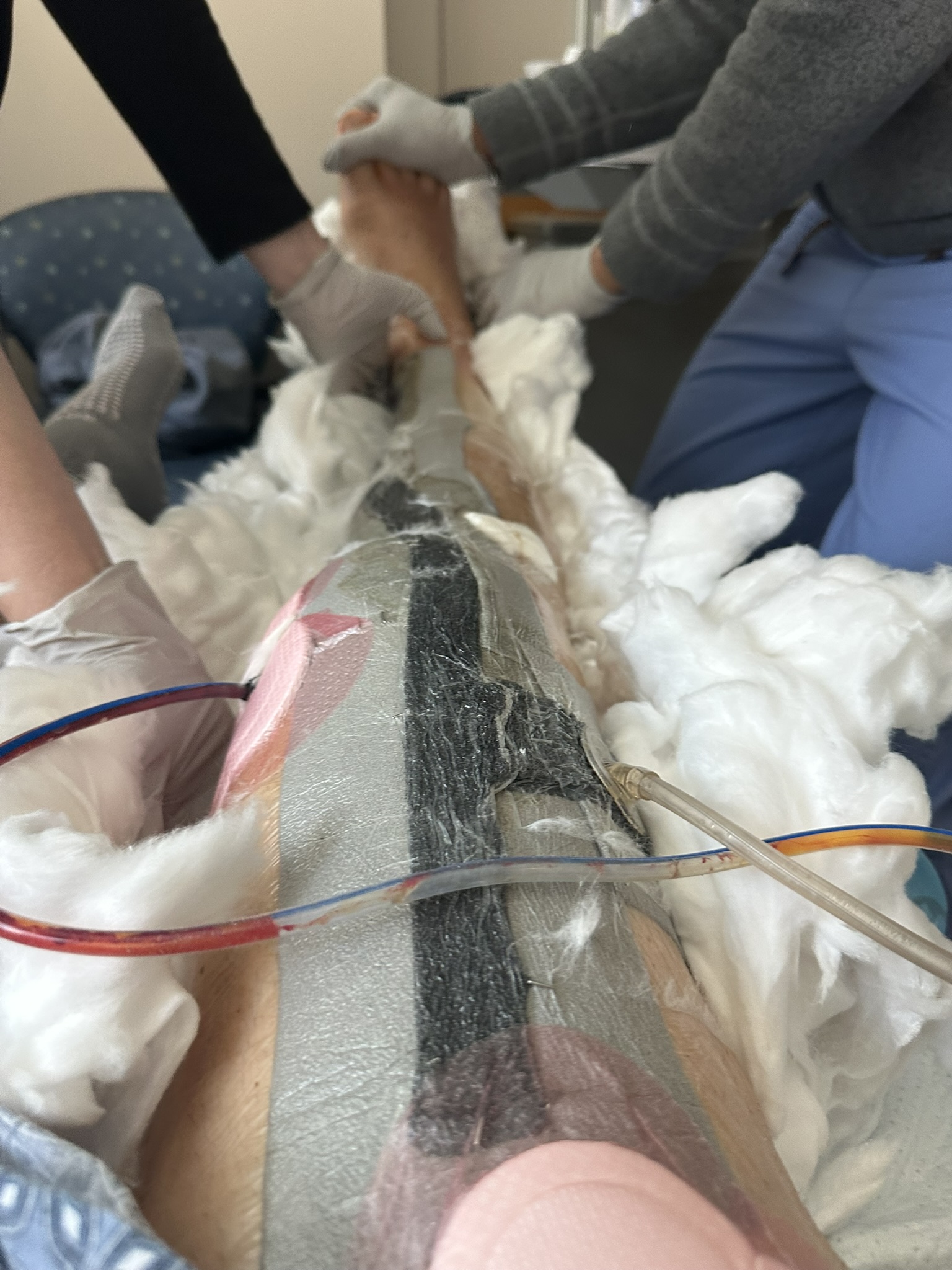
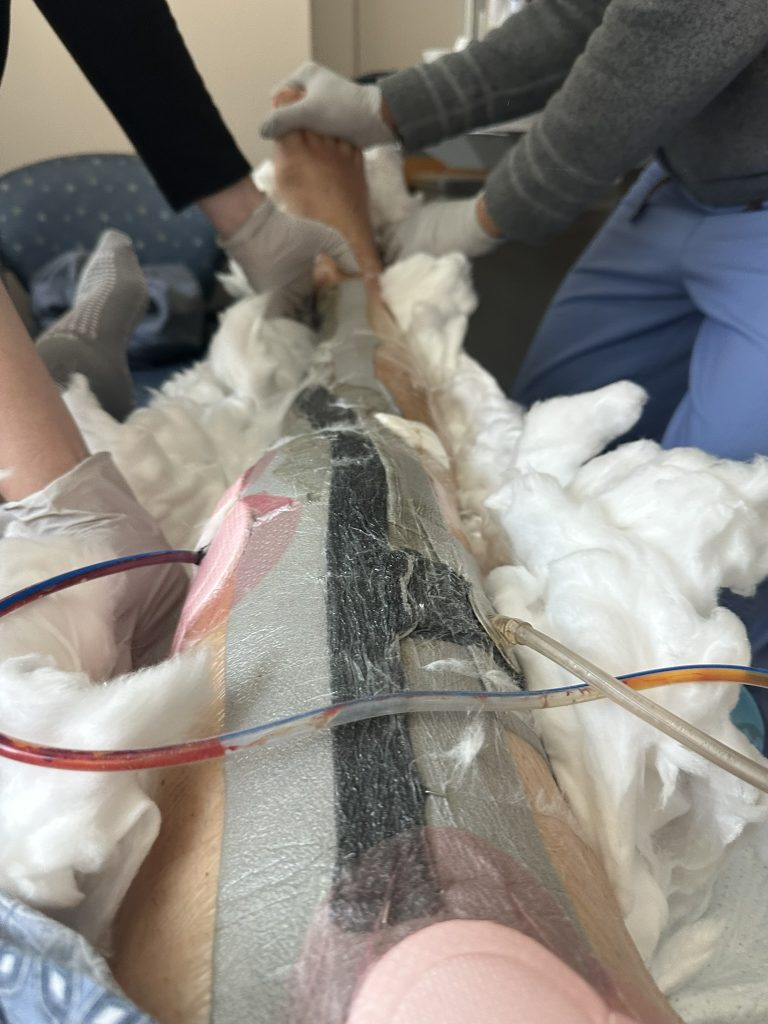
SLC stopped by to change the dressing on the right leg and install the brace.
The decision on rehab is pending, but our first choice of Whittier was turned down because of lack of beds. So I’m to go to Encompass Framingham. As of the time of writing it’s showing on the BCBS as pending June 23-29. The leg pain is pretty bad. I think it got a bit better overnight when I called for pain meds. Meghan stopped by with 30 mg oral morphine. It’ll take some time to kick in. I’ve not had hallucinations since switching. It’s hard to say if it’s more or less effective than oxycodone since the pain is in the ball of the foot on the right leg, and I still don’t have the ability to distinguish touch down there. It is worrisome. We’ll see what Encompass will do with it.
MGH appears well run, which is not to say that there are times when I have been dissatisfied. Above all, of course, is the need to ensure safety of the patients and freedom from obstacles to that purpose. The parts of the organization that I come into direct contact with are the nursing staff, the facilities in the ward, and the people that maintain those facilities. There are also the doctoring teams, and at the top, the superstar specialists and surgeons. In some ways, running a hospital must be like managing a sports team, a rock star, or an airline. They all have a clientele that is willing to repeatedly spend a lot of money to receive their services, and they must maintain their reputation for excellence. It costs a lot of money to maintain these services and reputation. The bottom line, however, must be that safety is essential, while the budget for safety and the financial benefit is impossible to measure. Back to the nursing team then, I am somewhat surprised that, unlike most major hospitals in the Boston area, MGH does not have a nurse’s union and it appears that management actively discourages it. An entry in Wikipedia reads as follows:
The vast majority of MGH’s thousands of registered nurses are not represented by a union. While sister hospitals in the Mass General Brigham (MGB) systems […] have nurses represented by the Massachusetts Nursing Authority, MGH nurses have historically voted against unionization.”
The entry goes on to notes that 88% of physicians voted in 2025 to unionize, but that Nurse Practitioner and Physicians Assistants are predominantly non-unionized. Reading some additional articles it seems that the board fears reputational loss, which in turn lessens the ability to attract top-rated staff, and overall loss of management control – both of which I understand. What I do miss, however, is the apparent lack of specialized training and a reliance on on-the-job training. This latter method, although essential part of training, carries the risk of instilling sub-optimal practices simply because they are easier to use. It also encourages the acceptance of work-arounds leaving the obstacles in place. For example, the nurses frequently complain about the new suction pumps used with the Jackson-Pratt bulb drains that pull liquids from the site of the surgery. In my case, I have two bulbs and sets of tubing that work with a single suction pump. The new pumps apparently have more features than the old pumps, but they set off alarms multiple times a day. The alarm is particularly discordant, and seems to have based on the sound made by a vuvuzela. This is obviously an annoyance to the patient, but it is also a distraction to the nurses who may be engaged in other tasks requiring their concentration.
It seems that the pumps were introduced using a train-the-trainer. Nurses also do not have any channels for expressing their frustration with the device. I was also disappointed when I mentioned the applicability of safety management systems in healthcare to Nick, my nurse for the day. He had never heard of the work of Jim Reason in this area. This was a change from my experience as a cancer patient at Brighham and Women’s 20 years ago. There, the physician team and nursing team did know about him, and his work developing the famous swiss-cheese model. Pushing further, I asked him if he had read anything by fellow Bostonian, Atul Gawande. Nick just asked if he was born here? (He wasn’t. He was born in Brooklyn, NY). Bottom line, I think that I would like nurses to recognize their calling and the role that they play in healthcare. As I’ve said many times since I’ve been here, I’d like the person asking about “where does it hurt?” and “what’s my pain level?” to actually have experienced pain themselves.
I’ve been reading up on my surgeon, Santiago Lozano-Calderon. SLC as I’ve referred to him here, or ‘Santy’ as members of his team call him. I see that the orthopaedic oncology area in which he works incudes the evaluation and treatment of primary benign and malignant tumors of bone and soft tissue, as well as metastatic bone disease. It’s an area where we don’t have all the answers and difficult to make precise diagnoses. It is eminently reasonable, that six weeks after my first appointment with him, I still don’t have a diagnosis.
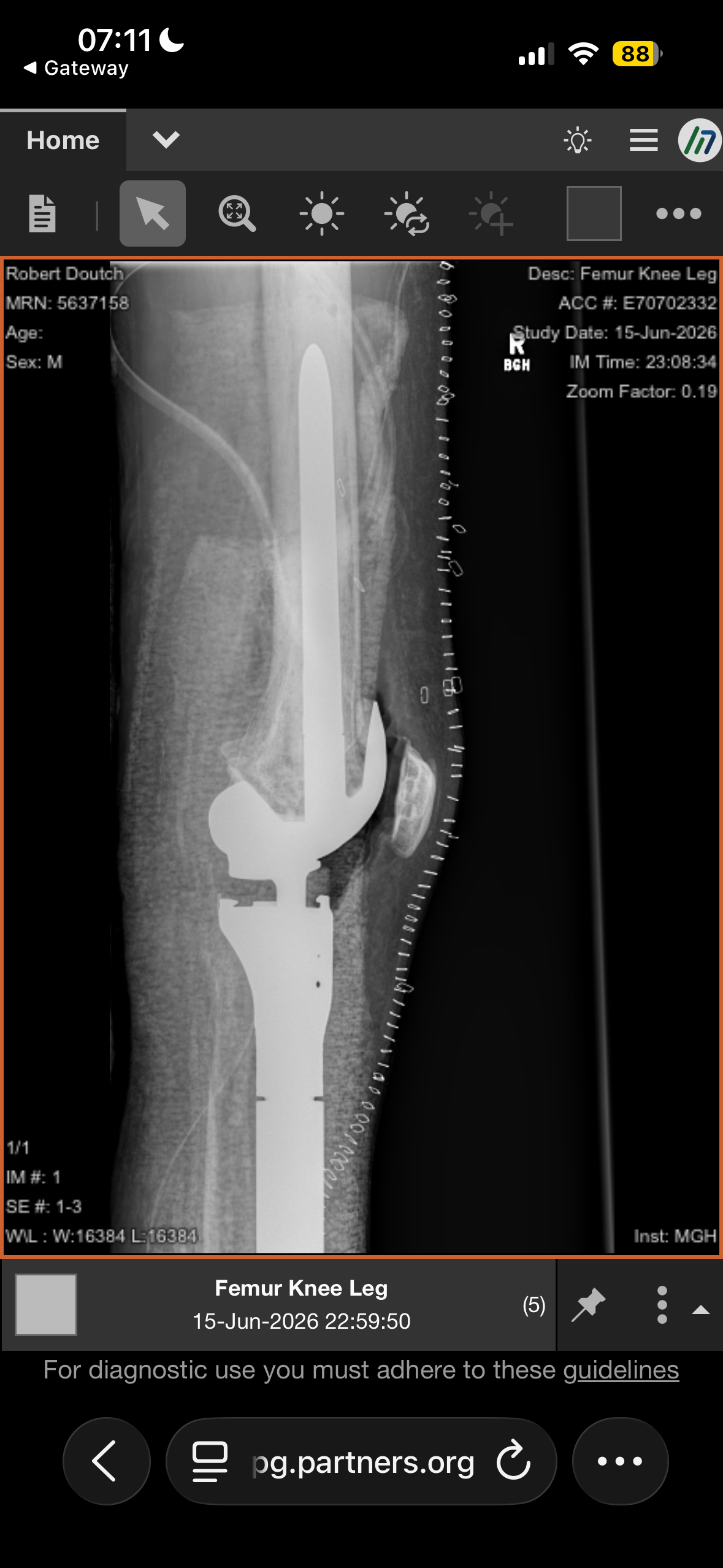
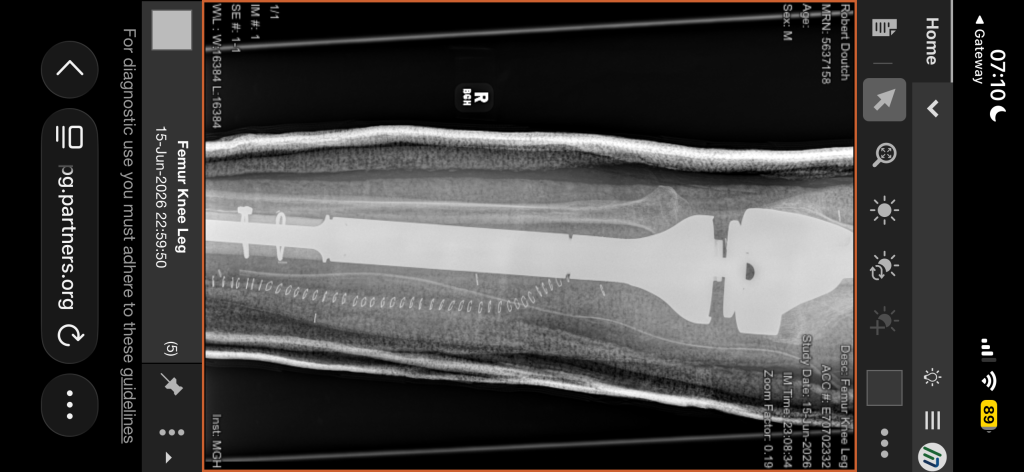
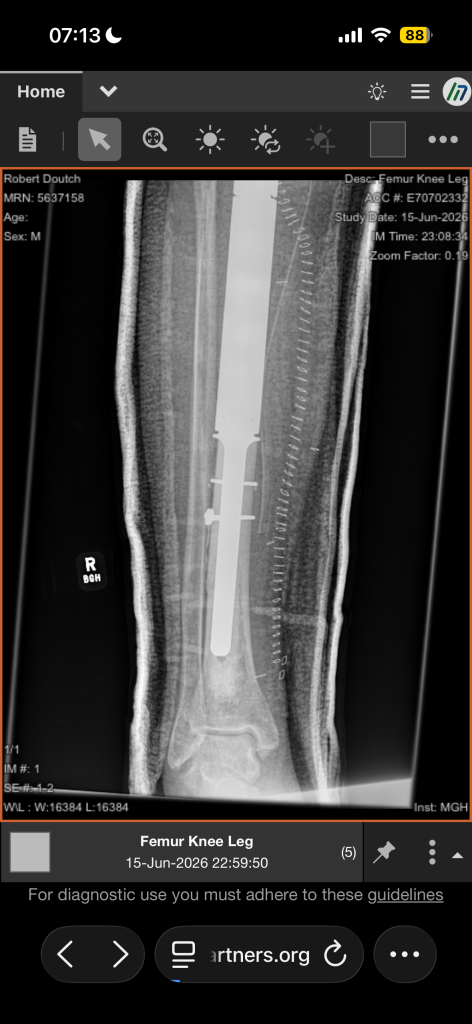
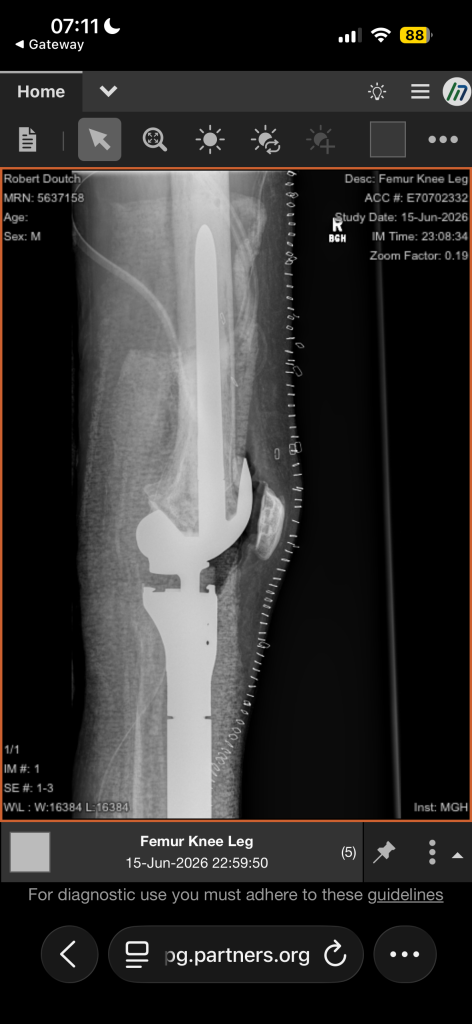
The second surgery on my right leg took place a week ago today. I was in the operating room for over 12 hours. Most of my right leg has been replaced. The bottom 8 inches or so of my femur is new, connected to a new artificial knee, connected in turn to a new tibia that connects to the few remaining inches of the old tibia. Given that my right hip is already artificial you’d think that would come with superpowers, but so far nothing. I was in a lot of pain, I mean a lot, for the first two days. Then with all the pain medications I started hallucinating but I’m on the mend now. Just finished up a session of PT, and hopefully later this week they’ll be able to discharge me to an acute care rehab closer to home.